Monday, October 14, 2019

POST FIVE (First Letter from Camp McCoy) 28 Dec 1942


Archway to Camp McCoy Hospital Ramp

Pvt. Charles D Knight
A.S.N. 31217744
Co. 7 2nd Div. Training Center
A.P.O. 2. Camp McCoy
Wisconsin
                                                     Dec. 28, 1942
Dear Mother, Dad and All,
     Well here I am a long way from home in Wisconsin. The last place on earth I had any idea of going. But no matter how far from home sweet home and all you loved ones my thoughts go back. In fact, many times I find myself living back in the good old State of Maine. If you promise me you'll try to keep smiling it will help out a lot. I just can't stop worrying. So be honest with me. Tell me everything and try to look at the bright side. Every cloud has a silver lining. {Most American soldiers of this time period in history had never traveled out of their state and many had only been around the local towns where they had been born.I really thought I would go south or south mid-west around Mississippi or Texas. That I would be swimming this winter. Instead you should see the ice and snow up here. Now is your chance. The red light has turned green and you can go. So Rush on the Mail and Rush it fast. I have been waiting a year it seems. {In reality, he had left home only a week earlier.Now send it until I tell you to stop. Write even if I don't answer. You'll never know what I've been through. I've taken a lot all around in just a short time. Hope it will let up just a little. I'll never give in. Mother, I'm going to make you proud of me. Yes, and don't forget someone else will be proud even if they can not or will not admit it. I have a feeling someday they will confess their mistake. Gee, will that day make me feel good. Not just so I can come out on top but to prove the fact it really pays in the end to throw back your shoulders, stick out your chin and take whatever you have to if you are in the right. I've put up a good fight so far, now if I can hear only two words "I'm sorry" I'll be happy, ------ in one way. {I don't think Uncle Charlie is writing about a family member. In an earlier letter he had mentioned about a person at his place of work at S.D. Warren. I am suspecting it is that person.}
     I'm not sure but I think I may be on the big gun just like Uncle Dave. {Uncle Dave was Uncle Charlie's mother's brother, David Anderson. Uncle Dave served in WW I. He went to France but never went into battle because the Armistice was signed before their training in France was completed.} You can hear them firing all the time. They have the real thing up here. Maybe I should say over here. Ha! Ha! {Maine is further north than Wisconsin in the United States.} I am in what they call the 2nd Infantry Division and they sure made history in the other war. It is the only Division in the whole Army that has the right to wear a chord around their left shoulder. It is a scarlet braid* and was given by the French Government in honor of what the 2nd Division did in the First World War. What a pretty shield they wear to show their Division. It is on the left sleeve and looks likes this.* Never saw any thing like it before. Looks swell. It kind of takes my eye. You know how I go for something like that. {He was an Eagle Scout in the Boy Scouts of America and had received many badges including the highest one possible.} Oh yes, I forgot to tell you on my left pocket I hope to have a few medals for shooting and some other things! Wait till I get home. None of the boys have ever had anything on their uniform like it. 
     This Division had practice in every kind of warfare except submarine. They now have men farther north learning to ski for a ski unit all dressed in white suits. I haven't seen them but they say they're great. I'm just not sure what I may do. Had a little drill and the Sargent said I was doing well---about face---right dress---left face---right face---parade rest---march time---etc. Harold Joy gave us all that in the Boy Scouts. I kept my mouth shut and went on. If you go to church and get in with the chaplain it helps a lot. They have more to say than one thinks. 
     Tell Eugene {brother} to forget the money and get on a farm if it will keep him out of the Army. {Uncle Charlie wanted to make sure his only other brother would be able to stay home and help their parents.Tell him to be a good fellow and remember a good sport isn't a fellow who does what everyone else tells him to do. His good time or fast life today gains him nothing tomorrow or in the future. I think a lot of him and would hate to see him go wrong. {Eugene is 8 years younger than Uncle Charlie, his big brother.} Is sister, Helen, still in love or has Joey and her parted? Ha! Ha! Ma, write a line for her. I know all her mail goes in one direction. South of the border down Florida. {Helen's future husband, Joey, works with a potato farmer that goes to Homestead, Florida, to plant a potato crop in the winter. In the summer, he plants a crop in Maine. Only a quarter of a mile from the Knight homestead in Gorham, Maine.} Be a good girl, Sis. I think you have a wonderful sweetheart. That is if you call him sweetheart. Don't let your face get red. It's O.K. I've said the same thing before, Helen. Yes my face is red. Her name was Helen too. Hee! Hee! 
     How is Dad the old scout. Tell him to take it easy on that light. How does he like it? I'll buy him some more batteries when they are gone. Tell him to use the car when he likes. I don't care. I never said much but he has been swell. I always knew it. {Grandpa Knight was not his biological father but had married Uncle Charlie's mother six months after his birth.} If he ever needs money for the doctor go up stairs in my suit coat pocket inside and you will find plenty. 
     Guess I will close soon for I know you want to sit down and write. I bet it has been hard waiting. So let's see what you can do. How about everything at home? I'm waiting. What a long ride out here. Wish I could sit down at home and tell you all about everything that has happened. Some day I will and it will be a long story. {He has no idea how long it will be!} Tell the Main's I was asking about them. 
     Mother, please send me a few things and I will send the money back later. My heavy brown sweater, army writing paper, stockings, men's toilet kit, the one Polly's folks gave me. Not the swank set. On my stockings and sweater sew a piece of white heavy cloth about so big for the number 7744 or sew it right into the cloth. Everything I have will be marked 7744 at all times. My whole number is 31217744 in Washington D.C. but 7744 is all I have to put on my clothes. Will that be asking too much? Thanks for everything. Looking to the day when I can come home. Good bye all. "Keep Smiling."  Best wishes from the west.
                                   Love xx
                                      Charlie
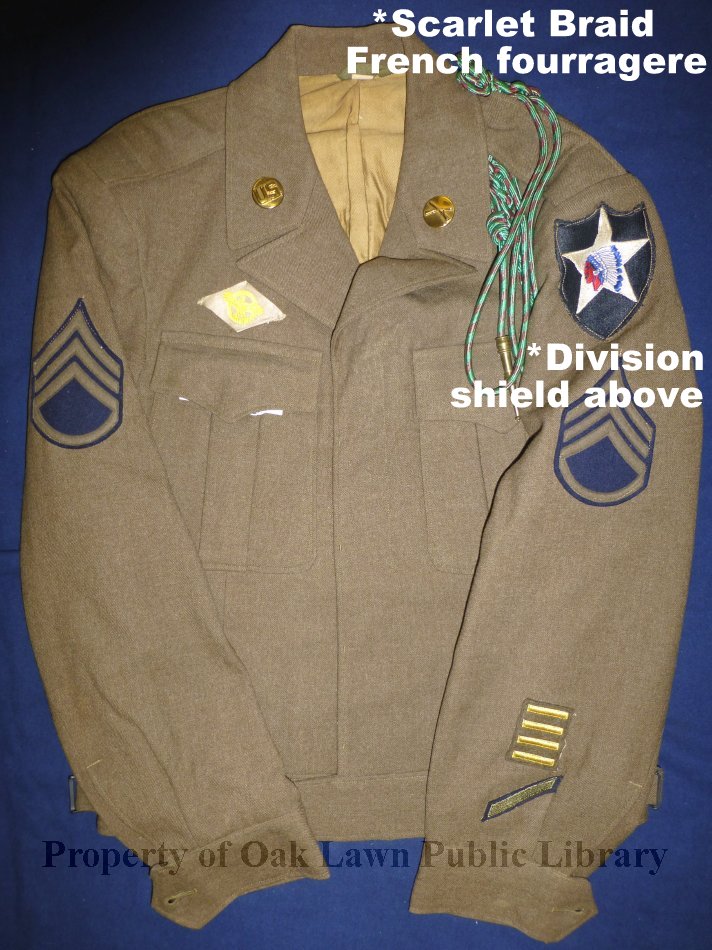
2nd Infantry Division uniform


copyright of letters and any original material Peter Lagasse

Wednesday, October 9, 2019

POST FOUR (Fort Devens, Massachusetts and Sore Arms) 25 Dec 1942


                                     Camp Devens, Massachusetts
Dec 25, 1942
Dear Mother, Dad, Helen and Eugene,
     My arm is feeling better. Now it is my left one. With two more shots to go. Oh well, it's all part of the army and I can take it if the rest can. The only trouble is they all aren't able to. The next morning after arriving, three fell flat at 4 o'clock in the morning when we lined up to start our day's work. We landed at camp about 5 o'clock. {Knowing Uncle Charlie left Portland, Maine on December 22nd, I would assume this is the afternoon of the 22nd.} Checked in had chow and a few other things, up to 9. Went to bed for the night. At 10 they called us out for a jab in each arm and a check up. Got to bed at 12:30 up at 4 {23rd}
On the go all the next day. I.Q. test and classification after our test had been ranked on an electric ranking machine. My interviewing officer gave me a tip and a swell write up. He said he knew my rank in the test but was not allowed to tell me. Here's what he said, " I am going to write you up for all I can. You have great mechanical ability and had higher rank than some of the college fellows."
I may go to school, not bad for an old hick {age 27} from the sticks of Maine. Some day I am coming home and when I go down to S.D. Warren {paper mill in Westbrook, Maine where he had been working before entering the army} I'll show them a little. I'll make them sit up. Maybe they won't think I'm such a damn fool after all. I can't help it, but I'd like to make one person regret. Haven't much more time before bed. It's been a little quiet here today but a big day tomorrow. Wish I could write to Polly {girlfriend} but I just haven't the time. Work from 5 to 7 Thursday on duty. What a hard day. But I still have more backbone than some of these babies and I mean that (a big baby). You should see them. By the looks of the ink and mistakes guess I'm tired. Hope you are all well.
Don't worry Ma. Don't write because --- I think I know something but I cannot tell. It's one of those military secrets you're not suppose to write. But --- I may ship out anytime. Get it? Tried to send you a telegram today but couldn't make it. Too many ahead and I had no time to wait. Hope you had a Merry Xmas and will have a Happy New Year. 
           Love from your boy in the Service
                                  Charlie xx
P.S Hope Dad's OK. Don't worry, Cheer up. Keep smiling. I'm OK.


{Enclosed was this Christmas Menu brochure and Uncle Charlie wrote on the back the following words.}
Christmas dinner at Camp Devens, Mass. 12-25-42. All chow is not like this but thanks, Mom, for bringing me up not to be fussy. It's a big help in this man's army. One fairs kind of slim if he doesn't like this or that. You know, Mother, I never kicked. Some things aren't so tasty as your cooking but -------- I'm o.k.
                                      Charlie


Christmas Menu

Inside menu

Fort Devens Entrance

Fort Devens Barracks and Chapel

S.D. Warren Paper Mill, Westbrook, Maine, where Uncle Charlie Worked

##Did you know? During World War II, as an alternative to rationing, Americans planted “victory gardens,” in which they grew their own food. By 1945, some 20 million such gardens were in use and accounted for about 40 percent of all vegetables consumed in the U.S.
In the earliest days of America’s participation in the war, panic gripped the country. If the Japanese military could successfully attack Hawaii and inflict damage on the naval fleet and casualties among innocent civilians, many people wondered what was to prevent a similar assault on the U.S. mainland, particularly along the Pacific coast.

This fear of attack translated into a ready acceptance by a majority of Americans of the need to sacrifice in order to achieve victory. During the spring of 1942, a rationing program was established that set limits on the amount of gas, food and clothing consumers could purchase. Families were issued ration stamps that were used to buy their allotment of everything from meat, sugar, fat, butter, vegetables and fruit to gas, tires, clothing and fuel oil. The United States Office of War Information released posters in which Americans were urged to “Do with less–so they’ll have enough” (“they” referred to U.S. troops). Meanwhile, individuals and communities conducted drives for the collection of scrap metal, aluminum cans and rubber, all of which were recycled and used to produce armaments. Individuals purchased U.S. war bonds to help pay for the high cost of armed conflict.

RATION BOOKS FROM UNCLE CHARLIE'S PARENTS


  ## Source 5 https://www.history.com/topics/world-war-ii/us-home-front-during-world-war-ii

copyright of letters and any original material Peter Lagasse 

Thursday, October 3, 2019

POST THREE (Off to War by Union Station in Portland, Maine)


Union Station will be where Uncle Charlie 
gets on a train in Portland, Maine 
to enter the US Army.

 Union Station was a train station in Portland, Maine.

     The building was opened on June 25, 1888, serving trains of the Boston and Maine, Maine Central and Portland and Ogdensburg railroads. Designed by Boston architects Bradlee, Winslow and Witherell, it was inspired by the designs of medieval French châteaux. It was a primarily granite building, with an 188 foot (57 m) clock tower.
     The Maine Central ended passenger rail service to the station in September 1960, and it closed on October 30 when the Boston and Maine moved its remaining trains out of the facility. On August 31, 1961, the building was demolished, and a strip mall built on the property.
UNION STATION IN PORTLAND, MAINE

UNION STATION IN WINTER

                A panoramic view of the interior of Union Station


                Four months before entering the US Army


    December 22, 1942

Time to get on the train.


Wednesday, September 25, 2019

POST TWO (FAMILY)


FAMILY
CAMP McCOY and CHARLES D. KNIGHT


The Great War ended 11 November 1918, and the world was at peace. Our soldiers were home and there was even discussions this could be the time when war could even become an ancient activity of manhood's pass. However, the Treaty of Versailles ending the Great War did not leave a sweet taste in every man's mouth.

For most, the future looked bright with promise proclaiming better days ahead. They were to be known as the Roaring 20's. New styles of music, dancing, the flappers, dress styles, and breaking away from the expectations of the pass brought new freedoms, new experiences, and new money. All was grand it appeared by many. The grandeur, however, was supported by false hopes, foolish expectations, and financial speculations led by a few.

The 1920's grandeur came crashing down as the greed of mankind began to be revealed once again. On October 24, 1929, later known as “Black Thursday” a large group of nervous investors began selling overpriced shares. With 12.9 million shares traded that day, the stock market crash that some had feared happened at last.

The panic had only begun. Nearly 16 million shares were traded after another wave of panic swept Wall Street five days later, on October 29 or “Black Tuesday”. Millions of shares ended up worthless, and many investors were wiped out completely. Some actually jumping to their death.

It would hit the "common man" as banks had to close causing people to discover in dismay their life savings were gone. They were penniless and soon many were standing in long lines at "soup kitchens" as thousands lost their jobs in the era that came to be known as the "Great Depression".

The Great Depression rippled across the great oceans causing countries across the world to feel the pain of empty stomachs; their dreams crashed upon the rocks of despair. Large groups of people felt their plight was caused by others. This opened the door for "false saviors" to come upon the scene.

Playing on the heartaches of these people and wanting to blame others for their plight, Mussolini of Italy, Hitler of Germany and others grabbed the opportunity to make statements and promises to satisfy the masses as they schemed to suffice their own greed of power, land and retribution. Another war was on the horizon.

Back in the United States in the small country town of Gorham, Maine, was a family of seven. The parents were Frank and Nina Knight. Their children were Charles, Waneta, Flavilla, Eugene and Helen. Even before the Great Depression this family struggled to make ends meet. However, with determination, hard work and faith in God they survived.
The young Knight family
The Knight children in the 1970's

Frank Knight planted his garden and sold his vegetables and strawberries at the road stand and worked at a local mill. Nina, his wife, was industrious with knitting and making broaches from butterflies and delicate flowers. The children would work at local canneries, cleaning homes, working on farms. Anything to help the family.
Frank and Nina Knight
The Knight Homestead Gorham, Maine

Across the "pond" trouble was brewing by the end of the 1930's. Germany struggling with its own depression and the inner struggle of wanting to gain back its spotlight on the stage of nationalism and recognition began to look at a rising star known as Adolph Hitler. Though short and at first unassuming, Hitler had a charisma and knew how to play on the emotions of his country men.

Even leaders of other countries considered him bright and a man that could help his struggling country of Germany. When he became bolder the western countries, such as, Great Britain and France considered diplomacy and began thinking maybe the Treaty of Versailles had been too harsh. Appeasement at all cost was the louder cry than the possibility of another war. 

Hitler had them in his hypnotic voice and charisma. By 1938, Hitler had grabbed Austria and Czechoslovakia. However, when he with the help of Russia took over Poland a new war began, known today as World War II. Soon other countries began to take sides but the United States with their Isolationists remained out of the war. President Roosevelt of the United States did use behind the scene tactics to aid Great Britain. Many quiet meetings occurred between the United States and Great Britain laying down a frame work if the United States ever did enter the war.

United States did enter the war but by the actions not of Germany. Japan attacked Pearl Harbor on December 7, 1941, and the United States of America  was at war. First with Japan but quickly with Germany and Italy too.


Soon, back in Gorham, Maine, a decision is made by my 27 year old uncle. My uncle, Charles David Knight, will enlist in the military December 1942 and will enter boot camp in the US Army at Camp McCoy in Wisconsin. Here he will become a soldier of the 2nd Infantry Division and will write 86 letters from Camp McCoy before crossing the Atlantic and into the European Theater of Operations. This blog will share those 86 letters and give us an inside look of a soldier preparing for war.


Lining Up to Sign Up

WORLD WAR II LEADERS
ALLIES


AXIS